
Overview
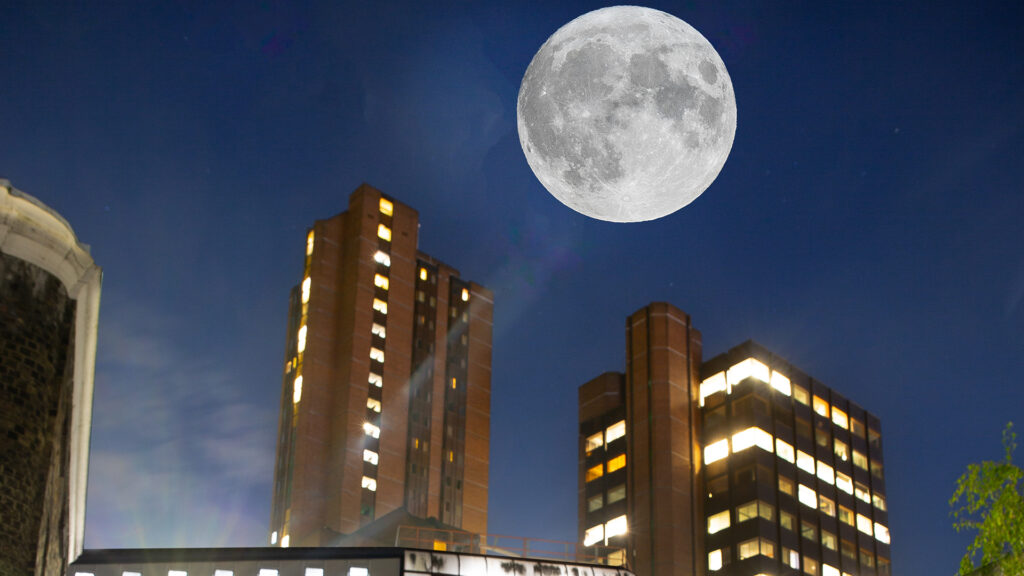
We like the unusual, so when asked by the Union Jack Club to photograph the supermoon we were never going to say no, its not part of our DNA!

The Brief
To capture one of the two supermoons in August behind the Union Jack Cub on a DSLR camera using a tripod.
We had to establish the time of moon rise and where in the sky it will be rise from. In addition what time it will appear behind the UJC in Waterloo. Will it be 20hrs or 22hrs when the moon will be in the position required to capture the shot. Importantly where should we set the tripod up to take the image? Some homework was needed to be done. This involved an initial sweep on the Internet, followed by asking a physicist friend who specialises in space. The UJC reached out to the Royal Astronomical Society as well and a Professor got in touch and carried out some calculations and also guided us to an app Stellarium We also discovered another app called PLANIT for location photography. All in all it was a good combination.
We carried out a recce the day before the 1st August to establish the position. We had anticipated the 1st attempt was going to be a fail due to cloud, who would have thought, August! We had higher hopes for the second attempt on the 30th August as the weather had begun to settle down.
We arrived in position and waited for it to appear in the dusk sky and then into the night and yes it was spectacular even in central London.

More about supermoons…
The last time two full supermoons appeared in the same month was in 2018 – and it will not happen again until 2037, according to the Italian astronomer Gianluca Masi, the founder of the Virtual Telescope Project.
Luckily it should be relatively easy to see the cosmic display if the skies are clear.
The Royal Observatory in Greenwich states: “So long as there’s not too much cloud, the full moon will be an unmistakable white orb in the sky. This is a good opportunity to use a small telescope or a pair of binoculars to see the moon’s detailed surface, or even try taking a few interesting moon photos.
“However, you can see the moon perfectly well with just your eyes. Seeing moonrise just after sunset, or moonset just before sunrise, will be an impressive sight as it will appear enormous compared to the surrounding landscape.”
According to the observatory, a supermoon appears up to 14% bigger and 30% brighter compared with the satellite at its farthest away.
Stargazers were treated to a very special double feature next month, with a pair of supermoons appearing in August – closing off with a rare blue moon.
The first, called Sturgeon, should be able to be seen from the UK on Tuesday 1 August with its peak at 7.31pm (BST) and just 222,159 miles (357,530km) away. According to the Old Farmer’s Almanac, the August full moon is traditionally known as the Sturgeon moon because of the abundance of that fish in the Great Lakes in August hundreds of years ago.
On Thursday 31 August, the moon will be even closer – a mere 222,043 miles (357,344km), with its peak at 2.35am (BST). And because it is the second full moon in a month it is called a blue moon.
For comparison, at its furthest point from the Earth, the moon is about 252,088 miles (405,696km) away.
The Guardian July 30th 2023, Jane Clinton
https://www.theguardian.com/science/2023/jul/30/supermoons-to-serve-up-double-treat-for-uk-stargazers-in-august